
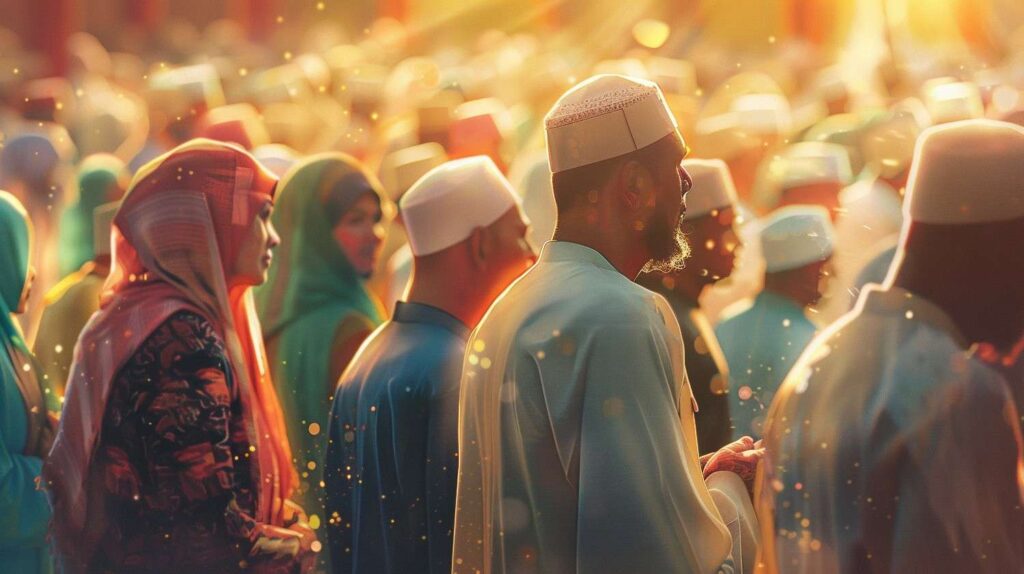
Before sunrise had fully spread across the sky, homes began waking earlier than usual to celebrate Eid ul Fitr festival. Everyone wore new clothes. The elders reminded everyone to eat something light before leaving for the prayer for Eid ul Fitr, while the children whispered excitedly. This early meal reflects the Sunnah, because Muhammad ( peace be upon Him) used to eat dates before going out on this blessed morning, as narrated in Sahih al-Bukhari.
One of the first duties is ensuring that those in hardship are not left behind. Before leaving for worship, families distribute obligatory charity so everyone may share dignity on this day. This teaching appears clearly in Sahih al-Bukhari, where the Prophet established charity before the gathering.
The streets slowly filled with people walking toward open grounds and mosques. What made that gathering unique was not only the performance of prayer but also the entire month of rewards gained through Ramadan worship. The khutbah that follows reminded us of the gratitude.
In Sahih Muslim, it is reported that the Prophet encouraged men, women, and even young girls to come out so the entire community could witness goodness together. People performed the Eid prayer in the following manner.
Make your intention to perform the Eid prayer for two rak’ahs.
Note that the Eid prayer does not require the usual adhan or iqamah to be called.
Start by saying Allahu Akbar (Takbeer-e-Tahrimah) and then fold your hands.
In the Hanafi method, you then say three extra Allahu Akbars (Takbeers) right before you recite the first Surah Al-Fatiha.
After reciting Surah Al-Fatiha, add another surah of your choice – then go ahead and complete that first rak’ah like you normally would.
In the second rak’ah, after you’ve recited your surahs, say a further three Allahu Akbars before you start to bend down into ruku.
On the fourth Allahu Akbar, you then go into ruku – and from there, just complete the rest of the prayer as you would normally.
After you’ve finished your prayer, be sure to listen to the khutbah (sermon) that gets preached – that is actually Sunnah to do.
The Prophet Muhammad actually said that Eid prayers were meant to be performed in congregation, as reported in both Sahih al-Bukhari and Sahih Muslim.
By the time families returned home, doorbells had already begun ringing.
On this blessed day, relatives came to homes sharing smiles and laughter. The quiet days of Ramadan now turned into cheerful joys.
This happiness is deeply rooted in faith. In Sahih al-Bukhari, the Prophet explained that those who fast have two joys: one when breaking the fast, and another when meeting their Lord. The first joy becomes visible on this day, when patience turns into thankfulness.
Children often notice details adults overlook: the fragrance of tea, polished shoes, new clothes, and elders speaking softly about past Eid mornings.

Every visit becomes part of memory, yet beneath the outward joy remains a spiritual lesson: celebration in Islam never separates from remembrance, thus Eid ul-Fitr prayer is the evidence that any joy embeds itself with remembrance of Allah.
Even simple acts—calling distant relatives, forgiving misunderstandings, giving charity, sitting longer with parents—become forms of worship when done sincerely with the intention of pleasing Allah.